Sensor-native
Environment, temperature, humidity, water, energy, yield, equipment uptime. Collected and verified automatically by AgOS.
 KO · EN
Impact by Design
What will change. Who will experience that change. How it will be proven. And how those results lead to the next investment and wider scale. AgUni asks these questions before a project begins.
Impact is designed into the way a project operates, shares value and earns the right to scale.
From ambition to implementation
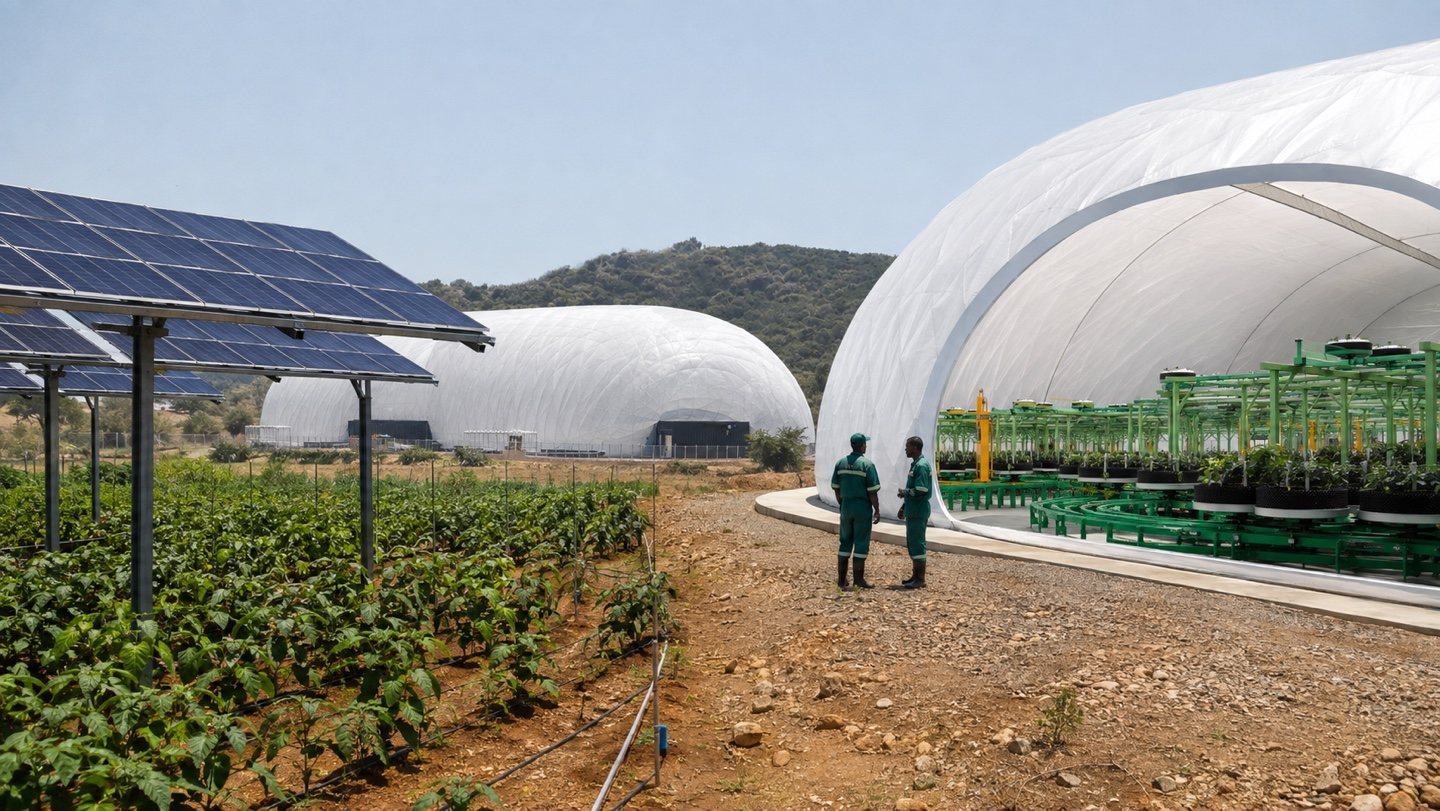
Policies and targets for climate adaptation, food security, land restoration and rural development already exist in abundance. But on the ground, technology alone does not move a project. Operable infrastructure, sustained demand, local implementation capacity, measurable outcomes and a financial structure that can read them are all needed at once. AgUni connects that gap.
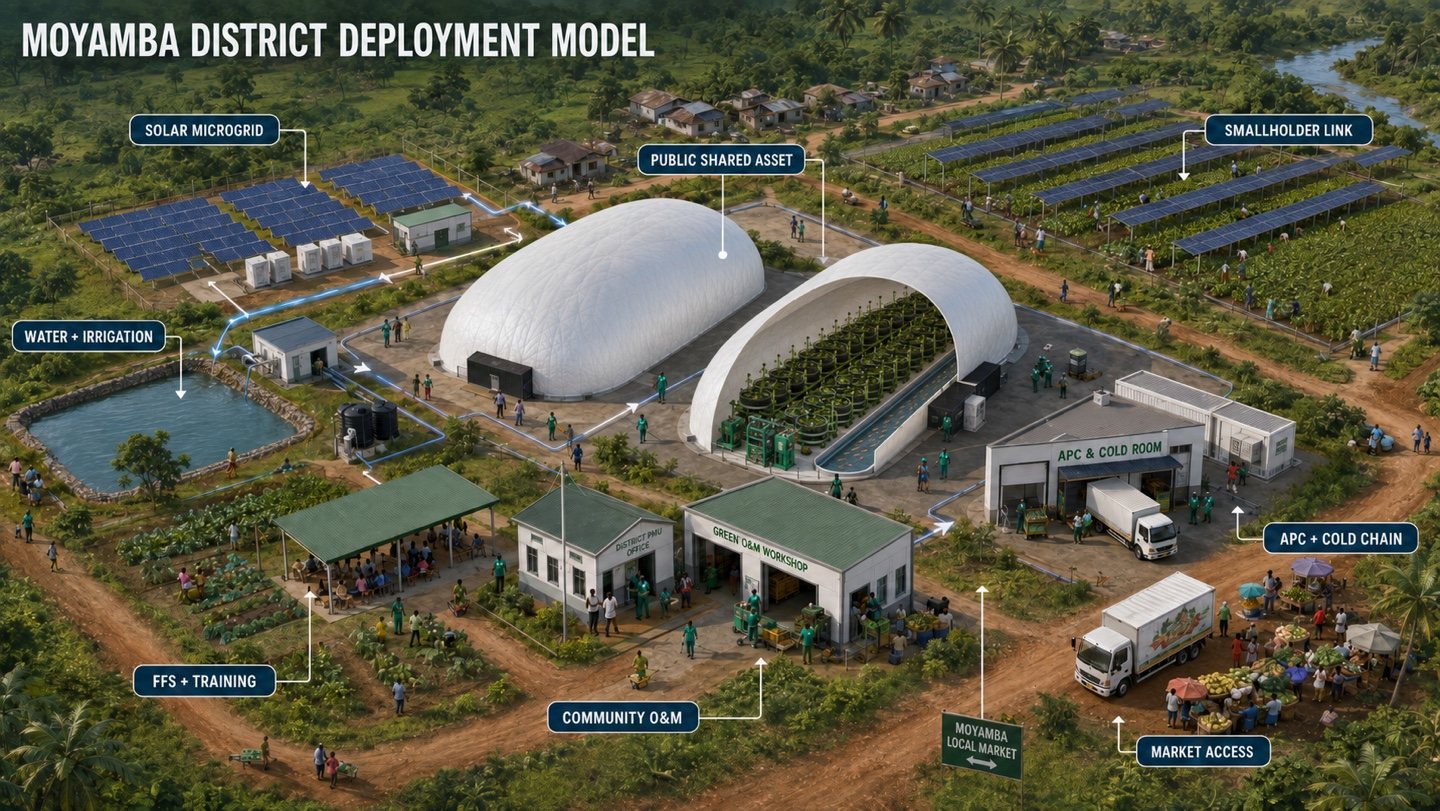
Moyamba District Deployment Model (concept) — infrastructure, energy, water, operator, market and training designed inside one project structure.
AgUni Impact Framework
We start by understanding the region: climate and water, land, energy, production and demand, existing growers and community structure.
Evidence — Climate · water · land · demand · income · supply-chain baseline
Production infrastructure, energy, operator, market, off-take, local participation and the financial instruments needed — designed inside one project structure.
Evidence — AgDome · AgOS · energy · off-take · operator · community model
AgOS continuously records environment, equipment, energy, production and quality, and builds operating baselines.
Evidence — Production · quality · uptime · water/energy · O&M
Stability of production, resource efficiency, local jobs and income, capacity transfer, climate adaptation and effects on land and ecosystems — defined per project.
Evidence — Food supply · income · employment · capacity · resource efficiency · restoration
Sensor-collected operating data, real contract and transaction data, and social indicators about people and place — verified in different ways and managed as one Evidence Layer.
Evidence — D-MRV + contracts/accounting + third-party evidence
Operating performance and cash flow bring the next capital, reinvested in the next infrastructure and the next region.
Evidence — Repayment · DSCR · private capital mobilization · reinvestment
Evidence layer
Environment, temperature, humidity, water, energy, yield, equipment uptime. Collected and verified automatically by AgOS.
Contracts, deliveries, local procurement, payments, off-take. Proven through contract and accounting records.
Employment, training, women's and youth participation, farmer income, community benefit, land tenure. Surveys, public data and third-party verification.
AgOS binds these three kinds of evidence into one project record. That is why D-MRV is not a carbon-measurement feature but an evidence system supporting operation, impact and finance at once.
Four impact pillars
Reduce production volatility so that needed food and raw materials are supplied when needed, even as climate shifts.
Use water and energy more precisely and manage climate risk inside the production system. Depending on the project, extend to restoration nurseries, land restoration and operating models linked to natural capital.
Design so that jobs, skills, operating capacity and market access remain in the region — not just a facility. Communities and cooperatives participate in operation and value creation, not only as beneficiaries.
When impact is measured and viability proven, private capital is more likely to follow public funding. AgUni designs so that operating data, financial performance and impact evidence are never separated.
SDG alignment
AgUni selects only the SDG targets where a project's actual activities connect to measurable results. Poverty, gender equality, reduced inequality and social stability are included only where a project has designed a real intervention and measurement.
 02Zero Hunger
2.4 회복력 있는 식량생산
 06Clean Water and Sanitation
6.4 물 이용 효율
 08Decent Work and Economic Growth
8.3 지역 경제활동
 09Industry, Innovation and Infrastructure
9.1 회복력 있는 인프라
 12Responsible Consumption and Production
12.2 자원의 효율적 이용
 13Climate Action
13.1 기후 적응 역량
 15Life on Land
15.3 토지 황폐화 중립 · 복원
 17Partnerships for the Goals
17.17 공공·민간·시민사회 파트너십
SDG icons are displayed in line with UN guidelines. Only targets with a designed intervention and measurement are linked per project.
From UNCCD COP17
What we confirmed again at UNCCD COP17 was simple. Technology alone does not move a project. Value has to remain in the region; there has to be capacity to operate it; results have to be verifiable; and on that evidence, the next capital has to be able to come in.
What AgUni wants to build in global projects is not a single unit. It is a production base a region can operate, prove and scale on its own.
Partnerships
Governments create policy and public purpose. Regions create implementation and continuity. Companies create technology and markets. Financial institutions create time. AgUni connects these actors so they see the same goals and the same data inside one project.
Government · MDB · DFI · Climate Funds · Corporates · Local Communities · Financial Institutions